Dubai Emirates Road Truck Ban 2025 in UAE

By Anushree . 30 Jan 2026
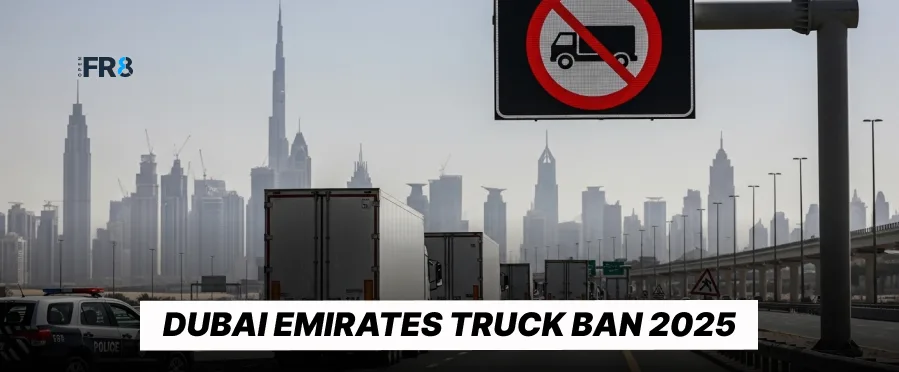
Imagine Emirates Road during peak hours before restrictions—heavy trucks mixing with private cars, regular traffic jams, and rising accident risks. To address this, Dubai's Roads and Transport Authority (RTA) and Dubai Police introduced a targeted truck movement restriction. The decision came after years of traffic data analysis showing that evening peak hours on Emirates Road were consistently among the most congested and accident-prone periods across Dubai's entire road network.
Start date: 1 January 2025
Location: Emirates Road (E611), between Al Awir Street and the Sharjah border, towards Sharjah
Timing: Evening peak hours, 5:30 PM to 8:00 PM
This guide explains:
- What the ban covers
- Why it was introduced
- Measured impacts on traffic and business
- How drivers and logistics firms can adapt
The restriction applies only during evening peak hours, not throughout the day, and forms part of a broader, data-driven strategy to improve traffic flow, road safety, and network efficiency across Dubai. Understanding the exact scope of this restriction is essential for fleet managers and independent truck operators who regularly use Emirates Road for cross-emirate freight movements.
What the Dubai Emirates Road Truck Ban Covers
It focuses on limiting truck movement during busy evening hours to keep traffic flowing. It applies only to a specific stretch of Emirates Road and only in the Sharjah-bound direction, making the rule clear and predictable for drivers. The restricted section runs from Al Awir Street all the way to the Sharjah border, covering one of the most heavily used freight corridors between Dubai and the Northern Emirates.
Official Restriction Details
| Item | Details |
| Restricted Vehicles | Trucks / heavy vehicles as per RTA classification |
| Restricted Direction | Towards Sharjah only |
| Restricted Section | Al Awir Street (E44) → Sharjah border |
| Restricted Time | 5:30 PM – 8:00 PM (Daily) |
| Effective From | 1 January 2025 |
| Enforcing Authorities | RTA (Roads and Transport Authority) & Dubai Police |
| Primary Fine | 1,000 AED |
| Black Points | 4 Points added to the driver's license |
| Additional Risks | Vehicle impoundment (7 days) or higher fines for repeat violations |
There is no full-day or 6 AM–10 PM ban on Emirates Road. The restriction is limited strictly to evening peak hours. Drivers who need to use Emirates Road during the restricted period can plan their journeys to either complete the route before 5:30 PM or resume movement after 8:00 PM to remain fully compliant.
Who Is Most Affected?
The Dubai Emirates Road truck ban 2025 mainly affects those relying on evening truck operations. Below are the groups most impacted:
| Stakeholder | Impact |
| Logistics & freight firms | Need to reschedule evening movements |
| Cross-emirate truck drivers | Must reroute or wait during peak |
| SMEs with small fleets | Higher sensitivity to delays and fuel costs |
| Private motorists | Benefit from smoother peak-hour traffic |
Small and medium logistics businesses operating with tight delivery windows are among the hardest hit, as rescheduling evening runs often requires additional driver shifts, higher fuel consumption on alternative routes, and increased coordination with receiving warehouses and clients.
Why Dubai Made This Move
The Dubai Emirates Road truck ban 2025 was introduced to tackle congestion and improve safety during peak traffic. With cars and trucks competing for space in the evenings, authorities stepped in to reduce accidents and smooth traffic flow. The ban is not a standalone measure but part of a coordinated traffic management framework that has been progressively rolled out across Dubai's major arterial roads over the past several years.
Safety and Traffic Flow Objectives
| Factor | Evidence |
| Accident risk | Truck–light vehicle overlap during peak hours |
| Congestion | Heavy traffic volumes on Emirates Road evenings |
| Road capacity | Limited ability to expand lanes in urban corridors |
| Environment | Reduced congestion lowers fuel burn and emissions |
Dubai Police confirmed the decision followed extensive engineering and technical studies balancing logistics needs with public safety. The studies included analysis of accident patterns, traffic volume data, and feedback from logistics operators, ensuring the restriction was both effective and practically manageable for the freight industry.
Official Statements
| Authority | Key Message |
| Dubai Police | Reduce accidents caused by truck–car overlap and ease congestion |
| RTA | Improve traffic flow, road safety, and redistribute truck traffic |
| Strategic partners | Decision coordinated with DP World, Dubai Airports, DET |
Environmental benefits—such as reduced fuel consumption and emissions—are considered secondary outcomes resulting from smoother traffic flow. However, as Dubai accelerates its sustainability agenda toward Net Zero 2050, these environmental gains are increasingly being factored into future road policy decisions as primary objectives rather than secondary ones.
Expansion of Truck Movement Bans Across Dubai
This isn't a one-off rule—it's part of a wider plan across the city. Similar truck restrictions are already active on major roads, and Emirates Road is the next step in Dubai's broader traffic management strategy. Fleet operators who regularly move goods across Dubai should familiarise themselves with all active restrictions to avoid accidental violations and ensure their route planning accounts for the full picture of truck movement rules across the emirate.
Truck Movement Restrictions Across Dubai
| Road / Area Type | Restriction Type | Specific Timings / Details |
| Al Ittihad St, Meydan St & Crossings | Total Ban | Trucks always prohibited |
| Sheikh Zayed Rd & Residential Areas | 16-Hour Ban | 6:00 AM – 10:00 PM |
| Medium-Congestion Urban Roads | Peak Hour Ban | 6:30–8:30 AM / 1:00–3:00 PM / 5:30–8:00 PM |
| Emirates Road (E611) | Evening Peak | 5:30 PM – 8:00 PM (Towards Sharjah only) |
The Emirates Road restriction mirrors the peak-hour model, not the extended 16-hour ban. This means trucks can still operate on Emirates Road during the majority of the day, and logistics companies can continue to use this corridor for morning, midday, and late-night freight movements without restriction.
Measured Results After Implementation
RTA and Dubai Police reported record positive outcomes following enforcement in 2025. The data collected in the first year of implementation demonstrates that targeted peak-hour restrictions can deliver measurable safety and efficiency improvements without significantly disrupting overall freight operations across the city.
| Metric | 2024 (Baseline) | 2025/2026 Results | Status / Change |
| Traffic incidents on key corridors | 75 | 37 | ↓ 51% reduction |
| Truck compliance (Emirates Road) | — | +7.7% | Improved |
| Truck compliance (SMBZ Road) | — | +5% | Improved |
| Avg. speed increase (Emirates Road) | — | +26 km/h | Faster flow |
| Avg. speed increase (SMBZ Road) | — | +19 km/h | Faster flow |
| Permits issued during restricted hours | — | ↓ 97% | High compliance |
Result: Faster travel times, fewer incidents, and better compliance without disrupting overall logistics flow. The 51% reduction in traffic incidents is particularly significant, as it represents dozens of avoided accidents that would otherwise have resulted in injuries, vehicle damage, road closures, and costly delays for the broader logistics network.
Business Impact: Wins and Challenges
For many businesses, the ban means safer roads and more reliable travel times. At the same time, it requires better planning—especially for companies that previously depended on evening deliveries. The businesses that have adapted most successfully are those that proactively restructured their delivery schedules and invested in route optimization tools to identify the most efficient alternatives to Emirates Road during the restricted hours.
Positive Outcomes
- Travel time: Reduced peak-hour delays
- Safety: Fewer truck-related incidents
- Planning: Clear, predictable restriction window
- Environment: Lower congestion-related emissions
Operational Challenges
- Evening delivery delays: Shift to off-peak or night operations
- Rerouting costs: Use approved alternative corridors
- Driver awareness: Mandatory training and briefings
Conclusion
The Emirates Road truck restriction (5:30 PM–8:00 PM, from January 2025) is a targeted, data-driven measure delivering safer roads, faster peak-hour traffic, higher compliance, and a better balance between logistics and urban mobility. The results from the first year of enforcement confirm that this approach works and signal that similar restrictions are likely to be introduced on additional corridors as Dubai continues to modernize its traffic management framework.
Action point: Review routes, adjust schedules, and brief drivers now. Looking ahead: Further corridor-specific restrictions are likely as Dubai continues optimizing traffic flow beyond 2026.
In addition to route bans, operators must carefully observe the Abu Dhabi Speed Limits for Trucks and Heavy Vehicles.